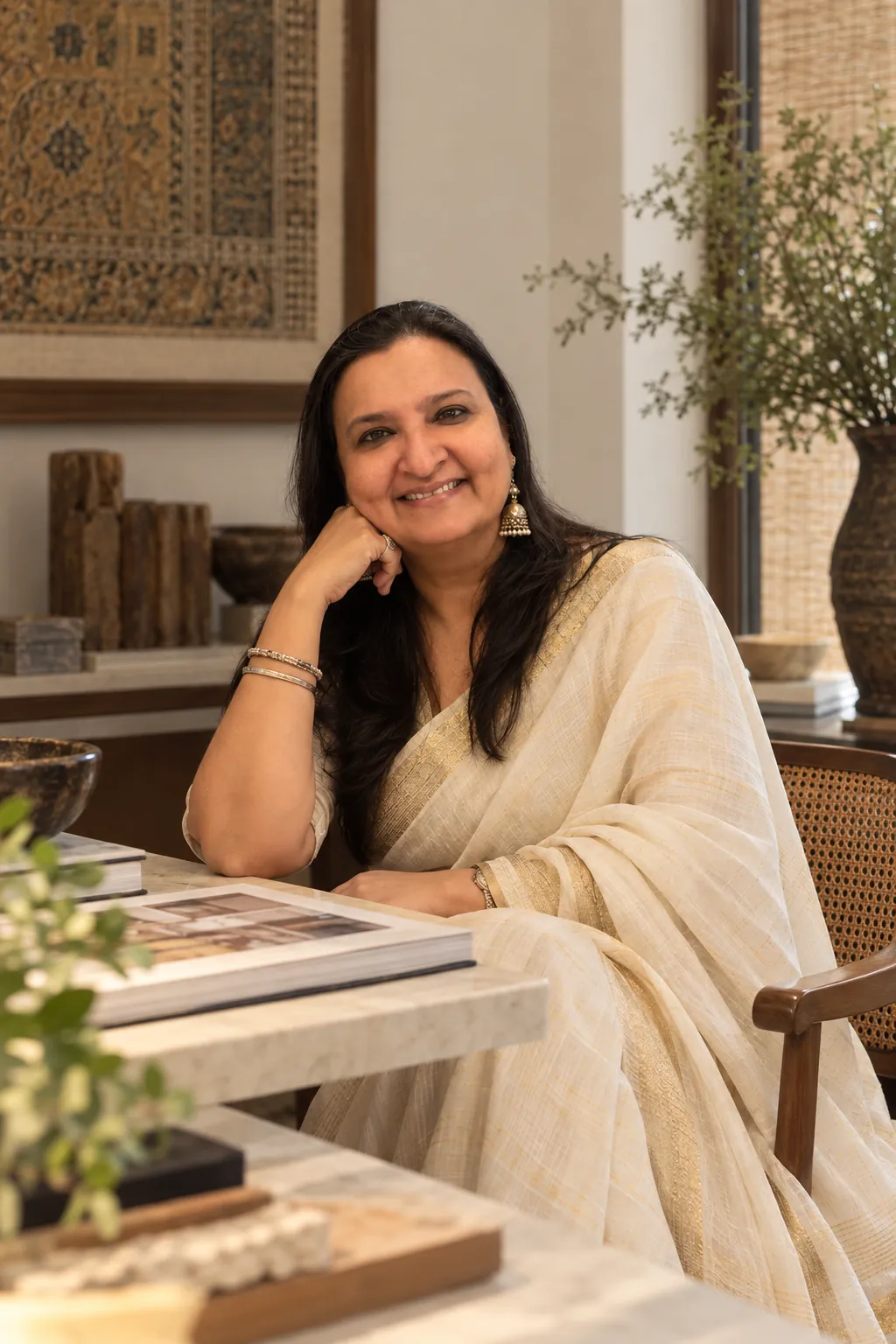
Roopali Mashruwala
Architect · Interior Designer
I think of every space as clay. You work with it, mould it, reshape it and keep working with it until it begins to reveal what it wants to become.
I am Roopali Mashruwala, and I like to call myself a space designer. I have been practising design since 1999, with a background in architecture and interior design. I primarily practise interior design, while also working across architecture, built heritage, exhibition design and curation.
At the heart of everything I do is a simple belief: design has emotion. A space has its own emotion, created through its proportions, volume, light, materiality and architecture. Layered onto this is the emotion of the people who inhabit it: the people who live there, work there, gather there or experience it. Whether it is a home, an office, a showroom or an exhibition, I believe a space should ultimately resonate with the people who use it.
The process of thinking design
For me, thinking about design is first and foremost about being in a state of calm and clear thinking. It does not necessarily begin with drawings or lines on paper. It begins with feeling, with visualisation, with experiencing a space in my mind and then understanding what it can become.
I think of every space as clay. You work with it, mould it, reshape it and keep working with it until it begins to reveal what it wants to become. The process is one of constant observation, intuition and refinement, until the space ultimately becomes a complete and cohesive work. For me, design is art: every space I design is, in a sense, a completed piece of art, a three-dimensional world that is not simply meant to be looked at, but to be inhabited. It should make people feel happy, content and comfortable.
A people-centric approach
I see design as fundamentally people-centric. The client, resident, user or visitor is always the starting point. This is why I don't believe that my work should have one recognisable visual formula. Each project looks, feels and behaves differently because each space responds to the person who inhabits it and to the way they want to experience and use it. My role is to understand that relationship and translate it into space.
The architecture gives a space its proportion and volume. Materials give it texture. Light gives it atmosphere. Objects, art and furniture give it personality. And the people who inhabit it give it meaning. That is why every project should be different, because every person, every story and every space is different.
Architecture, heritage and creativity
I studied architecture at the L.S. Raheja School of Architecture, before pursuing a Master's degree at the University of Michigan's Taubman College of Architecture and Urban Planning. Along the way, I developed a particular interest in built heritage and conservation, and I subsequently completed the BHSC course in built heritage and conservation, run jointly by Sir J.J. College of Architecture, the Chhatrapati Shivaji Maharaj Vastu Sangrahalaya and the Mumbai Metropolitan Region Heritage Conservation Society.
My interest in creativity extends well beyond architecture and interiors. I have always been drawn to painting, ceramics, craft and anything that allows me to participate in a creative process.
Indian contemporary
In terms of my own design language, I would describe my work as Indian contemporary. I enjoy working within an Indian context while maintaining clarity and simplicity of line. I like the contrast between contemporary forms and unexpected touches of the antique, elements that bring history, character and a sense of memory into an otherwise clean space.
My palette tends towards warmth and depth: beiges, mushrooms, greys, deep maroons, ochres and olives. I am drawn to natural materials, tactile surfaces and the quiet richness they bring to a space. I enjoy restraint, but I also enjoy moments of surprise.
The emotion of light
Light is one of the most important elements in my work. Natural light can completely transform the perception of a space, revealing its volume, texture and proportions throughout the day. Artificial light allows another layer of emotion to emerge after dark. I have a particular fondness for table lamps, floor lamps and individual sources of warm light: rather than simply illuminating a room, these smaller pools of light can create intimacy, warmth and atmosphere. For me, lighting is not something added at the end of a project. It is part of the emotional language of the space.
Ultimately, my work is less about creating a particular style and more about creating a particular feeling. Design has emotion, and every space, when thoughtfully designed, becomes its own three-dimensional work of art.
1989 to 1995
L.S. Raheja School of Architecture
1996 to 1998
University of Michigan, Taubman College of Architecture and Urban Planning (Master's)
2017
BHSC course in built heritage and conservation, Sir J.J. College of Architecture, CSMVS and MMR-HCS